PY-GREX: An Explainable Group Recommender Systems Toolkit
[](https://github.com/toledomateus/pygrex)
[](/LICENSE.md)
[](https://github.com/toledomateus/pygrex/issues)
[](https://github.com/toledomateus/pygrex/pulls)
[](https://badge.fury.io/py/pygrex)
---
A software toolkit for explainable group recommender systems, including several state-of-the-art explainability methods and evaluation metrics.
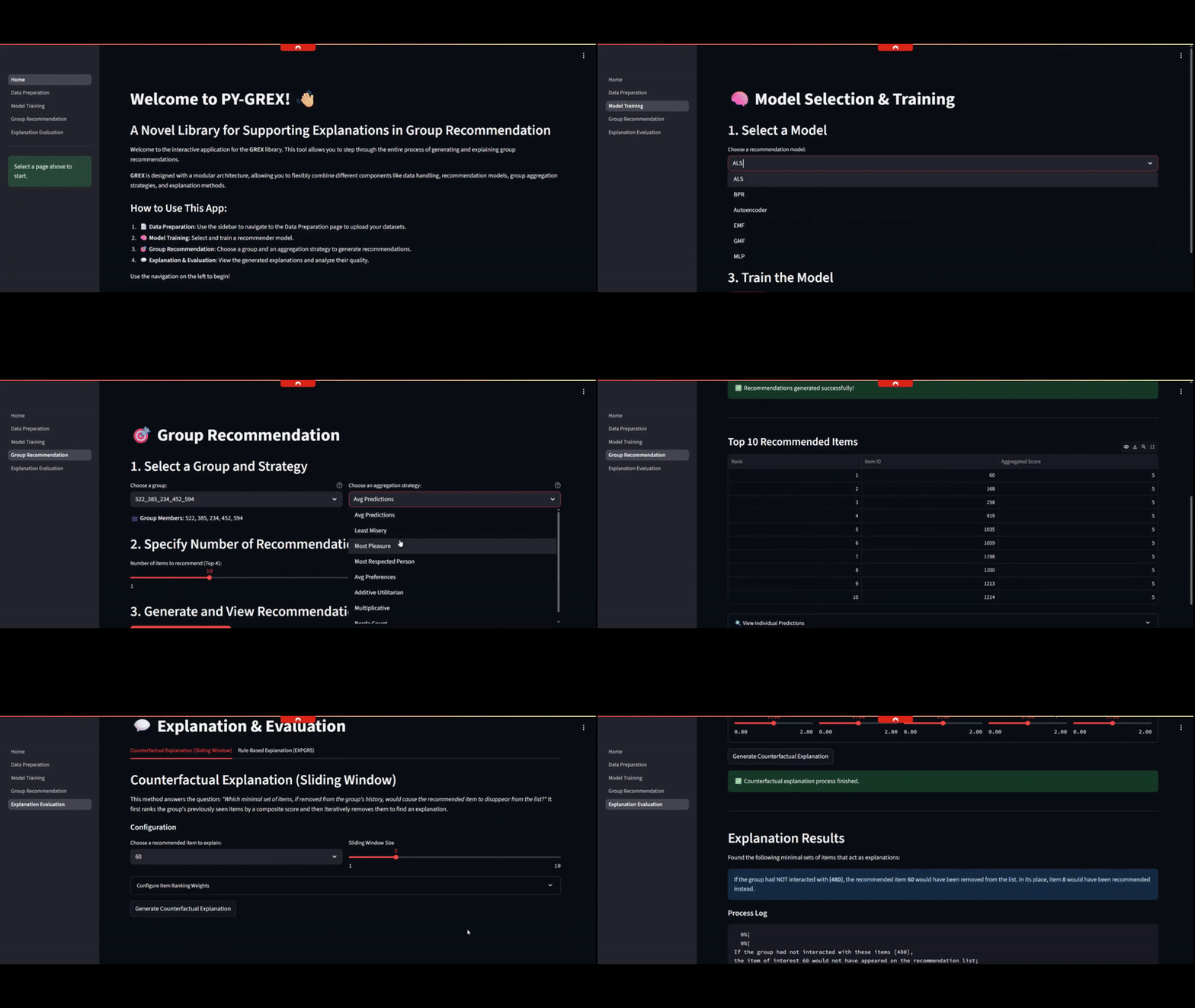
**➡️ [Platform live demo](https://pygrex.streamlit.app/)**
---
## About
PY-GREX addresses this critical need, offering a modular Python toolkit equipped with multiple state-of-the-art explainability algorithms to facilitate research and development in eXplainable AI (XAI) for Recommender Systems.
---
## 🚀 Features
PY-GREX provides a modular, end-to-end pipeline for explainable group recommendations.
- **Recommendation Models**:
- **Matrix Factorization**:
- Alternating Least Squares (ALS)
- Singular Value Decomposition (SVD)
- Bayesian Personalized Ranking (BPR)
- Explainable Matrix Factorization (EMF)
- **Neural Networks**:
- Generalized Matrix Factorization (GMF)
- Multi-Layer Perceptron (MLP)
- Neural Collaborative Filtering (NCF)
- Deep Autoencoder
- **Memory-Based**:
- Item-Based K-Nearest Neighbors
- **Group Aggregation Strategies**:
- **Consensus-Based**:
- Additive Utilitarian
- Multiplicative Utilitarian
- Average Satisfaction
- **Majority-Based**:
- Borda Count
- Plurality Voting
- **Fairness-Oriented**:
- Least Misery
- Most Pleasure
- Most Respected Person
- **Explanation Methods**:
- **Counterfactual**:
- Sliding Window Explainer (Counterfactual Explanations)
- **Rule-Based**:
- EXPGRS (Association Rules Explainer)
- **Local Explainers**:
- LORE4Groups (Local Rule-Based Explanations)
- **Evaluation Metrics**:
- **Accuracy**:
- Hit Ratio (HR)
- Normalized Discounted Cumulative Gain (nDCG)
- **Explainability**:
- Model Fidelity
- Gaussian Intra-List Diversity (GILD)
- Rule Support and Confidence
---
## 🏁 Getting Started
### Installation
You can install PY-GREX directly using pip:
```bash
pip install pygrex
```
This will install all the required dependencies automatically. PY-GREX requires Python 3.11 or higher.
### Local Development
If you want to run the project locally for development:
1. **Prerequisites**:
- Python 3.11 or higher
- Git
- Conda (recommended)
2. **Clone the repository**:
```bash
git clone https://github.com/toledomateus/pygrex.git
cd pygrex
```
3. **Create and activate a Conda environment**:
```bash
conda create -n pygrex python=3.11
conda activate pygrex
```
4. **Install in development mode**:
```bash
pip install -e .
```
This will install the package in development mode, allowing you to modify the source code and see the changes immediately without reinstalling.
### Docker
You can use Docker to execute the application. First of all, install Docker on your computer, and then:
Build and run:
```bash
docker compose up -d --build
```
Access the application at:
http://localhost:8501
---
## 🎈 Usage
### Running Locally
To run the Streamlit app locally:
1. **Install Streamlit**:
```bash
pip install streamlit
```
2. **Run the app**:
```bash
streamlit run Home.py
```
The app will be available at `http://localhost:8501`
### Interactive Web App
The easiest way to use PY-GREX is through the web application. It allows you to:
- **Upload or use default data** for users, items, and groups
- **Select and train** a variety of recommendation models
- **Generate group recommendations** using different aggregation strategies
- **Produce and evaluate explanations** for the recommendations
### Jupyter Notebooks
For detailed examples, check out the notebooks in the `notebooks/` directory:
- `expgrs_toy_example.ipynb`: Demonstrates the EXPGRS rule-based explainer with association rules
- `sliding_window_toy_example.ipynb`: Shows how to use counterfactual explanations with the Sliding Window method
- `lore4groups_toy_example.ipynb`: Illustrates local rule-based explanations using LORE4Groups
---
## 🤝 Contributing
Contributions are what make the open-source community such an amazing place to learn, inspire, and create. Any contributions you make are **greatly appreciated**.
If you have a suggestion that would make this better, please fork the repo and create a pull request. You can also simply open an issue with the tag "enhancement".
1. Fork the Project
2. Create your Feature Branch (`git checkout -b feature/AmazingFeature`)
3. Commit your Changes (`git commit -m 'Add some AmazingFeature'`)
4. Push to the Branch (`git push origin feature/AmazingFeature`)
5. Open a Pull Request
---
## 📚 Citation
If you use PY-GREX in your research, please cite our paper:
```bibtex
@inproceedings{Toledo2026GREX,
author = {Toledo, Mateus and Yera, Raciel and Barranco, Manuel J. and Dutta, Bapi},
title = {{GREX}: A Platform for Supporting Explanations in Group Recommender Systems},
booktitle = {Intelligent Data Engineering and Automated Learning -- {IDEAL} 2025},
year = {2026},
publisher = {Springer Nature Switzerland AG},
address = {Cham},
series = {Lecture Notes in Computer Science},
volume = {16239},
pages = {1--13},
doi = {10.1007/978-3-032-10489-2_9}
}
```
---
## 📜 License
This project is licensed under the MIT License. See the `LICENSE` file for details.